
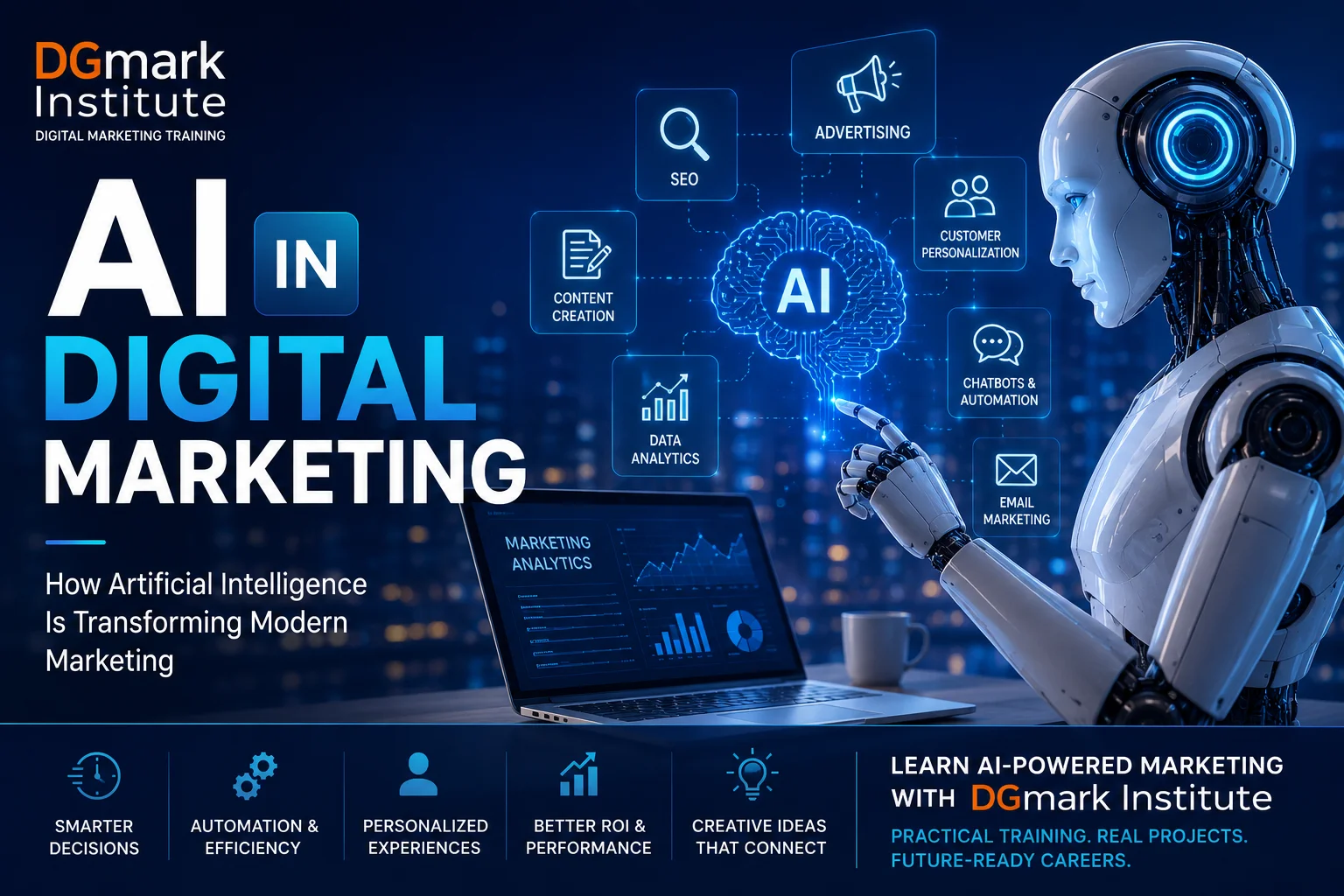
DGmark Institute recognizes that artificial intelligence is rapidly changing the way businesses plan, execute, and measure their digital marketing strategies. From content creation and search engine optimization to advertising, customer personalization, analytics, and automation, AI has become an important part of the modern marketer’s toolkit. As businesses increasingly rely on data and technology to connect with customers, understanding AI in digital marketing is becoming an important skill for students, professionals, entrepreneurs, and marketers.
Digital marketing has always been closely connected with technology. Search engines, social media platforms, analytics systems, advertising platforms, and marketing automation have continuously changed how brands communicate with audiences. Artificial intelligence is the next major development in this evolution.
Today, marketers can use AI to analyze large amounts of information, identify patterns, generate content ideas, automate repetitive tasks, improve campaigns, and create personalized customer experiences. However, AI does not eliminate the need for human marketers. Instead, it gives marketers powerful tools to work faster, analyze information more effectively, and focus more time on strategy and creativity.
What Is AI in Digital Marketing?
AI in digital marketing refers to the use of artificial intelligence technologies to perform, improve, or automate marketing activities.
Traditional marketing often requires marketers to manually research audiences, analyze data, write content, create variations of advertisements, and monitor campaigns. AI can assist with many of these activities by processing information and generating recommendations or outputs much faster.
AI-powered marketing can be used for:
- Content research and creation
- Keyword research and SEO
- Advertising copy generation
- Audience analysis
- Customer segmentation
- Chatbots and customer support
- Email marketing
- Social media content
- Marketing automation
- Predictive analytics
- Image and video creation
- Campaign optimization
- Personalization
The objective is not simply to automate everything. The real value of AI comes from combining technology with human marketing expertise.
Why Is AI Becoming Important in Digital Marketing?
The digital marketing industry produces enormous amounts of data every day. Businesses receive information from websites, social media platforms, advertising campaigns, customer interactions, email campaigns, and search engines.
Analyzing all this information manually can take considerable time.
AI can help marketers process information and identify patterns more efficiently. For example, AI can assist in finding content ideas, generating multiple advertising variations, organizing keywords, analyzing customer behavior, and automating repetitive marketing activities.
For marketers, this can mean greater productivity.
Instead of spending hours performing repetitive tasks, marketers can use AI tools to accelerate the initial work and spend more time making strategic decisions.
DGmark Institute’s current digital marketing curriculum specifically emphasizes AI integration, practical training, and the use of modern AI tools as part of preparing learners for the changing marketing industry.
How AI Is Changing Digital Marketing
AI is influencing almost every major area of digital marketing. Let’s look at some of the most important applications.
1. AI for Content Marketing
Content marketing requires constant research, planning, writing, editing, and optimization.
AI tools can assist marketers with brainstorming blog topics, creating content outlines, generating headline ideas, summarizing information, rewriting copy, and developing social media content concepts.
For example, a marketer working on a campaign for a fitness brand could use AI to generate content ideas around workout routines, nutrition, fitness tips, and customer questions.
However, marketers should not publish AI-generated content without reviewing it. Human editing remains important for accuracy, originality, brand voice, emotional connection, and useful information.
The best approach is to use AI as a creative assistant rather than treating it as a complete replacement for a content strategist.
2. AI for Search Engine Optimization
SEO is another area where AI is becoming increasingly useful.
Marketers can use AI to assist with:
- Keyword research
- Search intent analysis
- Topic clustering
- Content outlines
- Meta title ideas
- Meta descriptions
- Content optimization
- Competitor research
- SEO content analysis
AI can help identify relationships between topics and keywords that might otherwise take significant time to research manually.
However, SEO still requires human judgment. Search visibility depends on factors such as content quality, relevance, technical performance, user experience, authority, and search intent.
AI can accelerate SEO workflows, but marketers still need to understand how search engines and users behave.
3. AI in Social Media Marketing
Social media managers constantly need fresh content ideas.
AI can help generate:
- Instagram captions
- Reel ideas
- Content calendars
- Social media hooks
- Hashtag suggestions
- Creative concepts
- Audience personas
- Campaign ideas
AI can also help marketers adapt one idea for multiple platforms.
For example, a long-form blog can be transformed into a LinkedIn post, Instagram carousel concept, short video script, and email newsletter outline.
This can significantly improve content productivity.
At the same time, successful social media marketing still depends on authenticity. Audiences can recognize generic content, so marketers need to add their own brand personality, experiences, opinions, and creative direction.
4. AI-Powered Advertising
Paid advertising generates large amounts of performance data.
AI can assist marketers in analyzing campaign information and identifying opportunities for optimization.
It can support activities such as:
- Ad copy variations
- Creative concepts
- Audience analysis
- Campaign optimization
- Performance analysis
- Budget recommendations
- Conversion analysis
Advertising platforms themselves increasingly use machine learning and automation to help advertisers reach relevant audiences.
Marketers therefore need to understand not only how to create advertisements but also how automated advertising systems work.
5. AI Chatbots and Customer Service
AI-powered chatbots can interact with customers and answer common questions.
For example, an online business can use a chatbot to help customers find:
- Product information
- Pricing details
- Delivery information
- Appointment options
- Frequently asked questions
- Basic troubleshooting information
This can help businesses provide faster responses while reducing repetitive workload for customer-service teams.
However, complicated or sensitive customer issues may still require human assistance.
The strongest customer experience often combines AI automation with human support.
6. AI for Email Marketing
Email marketing becomes more effective when messages are relevant to individual customers.
AI can assist marketers with:
- Subject-line ideas
- Email copy
- Audience segmentation
- Personalized recommendations
- Send-time optimization
- Campaign analysis
- Automated follow-ups
For example, an e-commerce business could use customer behavior to recommend products that are more relevant to an individual’s interests.
Personalization can make email communication more useful than sending the same generic message to an entire database.
7. AI in Marketing Analytics
Data is one of the most valuable resources available to digital marketers.
AI can help marketers identify patterns in campaign data and customer behavior.
Instead of simply looking at numbers such as clicks or impressions, marketers can use AI-assisted analysis to explore questions such as:
- Which audience is converting best?
- Which campaign is generating better results?
- Which content receives the most engagement?
- Where are customers dropping off?
- Which marketing channel is producing better results?
These insights can help marketers make more informed decisions.
The marketer’s role remains important because data does not automatically explain the complete business situation. Human interpretation is needed to turn insights into strategy.
AI Tools Used in Digital Marketing
The AI ecosystem is expanding rapidly, with tools designed for different marketing tasks.
Depending on the objective, marketers may use AI tools for writing, research, design, video production, SEO, analytics, automation, and customer engagement.
DGmark Institute highlights AI tools within its digital marketing curriculum and provides practical exposure to various tools. Its published curriculum has included tools such as ChatGPT, Gemini, Copy.ai, Adobe Firefly, InVideo, Predis.ai, ElevenLabs, Synthesia, and other AI platforms.
The exact tools available in the curriculum can evolve as the AI industry changes. This is important because new AI platforms and features are introduced regularly.
Rather than learning one tool permanently, marketers should develop the ability to understand what different AI tools can do and select the appropriate technology for each marketing problem.
Benefits of Using AI in Digital Marketing
AI provides several potential advantages for marketers and businesses.
Faster Content Production
AI can help generate initial drafts, ideas, outlines, and variations quickly.
Better Productivity
Repetitive tasks can be accelerated through AI-powered workflows.
Data-Driven Decisions
AI can help analyze large datasets and identify patterns.
Personalization
Businesses can use customer data to create more relevant marketing experiences.
Automation
Routine activities can be automated, allowing marketers to focus on higher-value work.
Creative Assistance
AI can provide new ideas for campaigns, content, visuals, and advertising concepts.
Scalability
Businesses can create and manage more marketing variations without increasing manual workload at the same rate.
Can AI Replace Digital Marketers?
One of the biggest questions surrounding AI is whether it will replace digital marketing professionals.
The more realistic answer is that AI is likely to change the responsibilities of marketers rather than completely eliminate the profession.
A marketer still needs to understand:
- Customer psychology
- Brand positioning
- Business objectives
- Marketing strategy
- Communication
- Creativity
- Campaign planning
- Data interpretation
- Ethical considerations
AI can generate a social media caption, but it does not automatically understand a company’s complete business strategy.
AI can suggest keywords, but a human still needs to determine which topics are commercially valuable.
AI can generate an advertisement, but marketers need to decide whether the message represents the brand appropriately.
Therefore, the future belongs to marketers who know how to combine marketing fundamentals + AI skills + human creativity.
Why Learn AI as Part of Digital Marketing?
Digital marketers who understand AI can potentially work more efficiently than professionals who rely entirely on manual processes.
For students entering the industry, learning AI alongside traditional digital marketing skills can provide exposure to modern workflows.
DGmark Institute incorporates AI tools into its digital marketing programs and describes its training as practical and industry-oriented, including hands-on work with AI tools and real-world marketing activities.
Learning AI as part of digital marketing can help students understand not only individual tools but also how those tools fit into broader marketing strategies.
Skills Modern AI-Powered Marketers Should Develop
AI knowledge alone is not enough.
Future-ready marketers should develop a combination of technical and creative skills.
Digital Marketing Fundamentals
Understand SEO, social media, advertising, content marketing, email marketing, analytics, and conversion optimization.
AI Literacy
Understand how AI tools work, their strengths, limitations, and appropriate use cases.
Prompting Skills
Learn how to provide clear instructions to AI systems and refine outputs effectively.
Data Analysis
Develop the ability to interpret marketing metrics and make decisions based on evidence.
Creativity
Use AI to support creative thinking rather than relying entirely on generated ideas.
Communication
Learn to communicate strategies and campaign results clearly to clients and teams.
Critical Thinking
Always verify AI-generated information and evaluate whether an output actually supports the marketing objective.
How Businesses Can Start Using AI in Marketing
Businesses do not need to automate every marketing activity immediately.
A better approach is to start with repetitive tasks.
For example:
Step 1: Identify repetitive marketing activities.
Step 2: Select an AI tool that can assist with the task.
Step 3: Test the tool on a small project.
Step 4: Review the output carefully.
Step 5: Measure whether the tool saves time or improves results.
Step 6: Build the successful process into a larger workflow.
This approach helps businesses use AI strategically rather than adopting tools simply because they are popular.
The Future of AI in Digital Marketing
AI will continue to influence digital marketing as businesses collect more data and marketing platforms become increasingly automated.
We can expect continued development in areas such as:
- AI-powered search
- Automated content workflows
- Personalized customer experiences
- Predictive analytics
- AI-generated creative assets
- Marketing automation
- Conversational marketing
- Automated campaign optimization
- AI-assisted SEO
- Omnichannel personalization
The biggest change may not be that AI replaces marketers, but that marketers who use AI effectively become significantly more productive.
This means digital marketing education will also need to evolve.
Institutes and training programs that integrate practical AI tools into their curriculum can help learners become familiar with the technologies being used in modern marketing environments. DGmark Institute’s current course information emphasizes AI-integrated training, practical projects, and exposure to multiple digital marketing tools.
Conclusion
AI in digital marketing is transforming how businesses research, create, advertise, communicate, and measure their marketing activities. From content creation and SEO to social media, paid advertising, analytics, personalization, and automation, artificial intelligence is becoming an important part of the modern marketing ecosystem.
However, successful AI-powered marketing is not simply about using as many tools as possible. The real advantage comes from knowing when, why, and how to use AI.
Marketers still need strategy, creativity, communication skills, customer understanding, and critical thinking. AI can accelerate the work, but humans remain responsible for the decisions behind the strategy.
For students and professionals planning a career in digital marketing, learning AI alongside traditional marketing skills can be a valuable step toward becoming future-ready. Programs such as those offered by DGmark Institute combine digital marketing fundamentals with AI tools and practical learning, helping learners understand how emerging technologies can be applied to real marketing activities.
The future of digital marketing is not simply AI versus humans. It is AI working with skilled marketers to create smarter, faster, more personalized, and more effective marketing experiences.
Frequently Asked Questions About AI in Digital Marketing
1. What is AI in digital marketing?
AI in digital marketing means using artificial intelligence technologies to assist with marketing activities such as content creation, SEO, advertising, analytics, personalization, customer service, and automation.
2. Why is AI important for digital marketers?
AI can help marketers save time, analyze information, automate repetitive tasks, generate ideas, personalize campaigns, and improve marketing workflows.
3. Can AI replace digital marketers?
AI is unlikely to completely replace skilled marketers. Instead, it is changing how marketers work. Human strategy, creativity, communication, customer understanding, and decision-making remain important.
4. What AI tools are used in digital marketing?
Marketers use different AI tools for content, SEO, design, video, research, analytics, automation, and advertising. DGmark Institute’s curriculum includes exposure to multiple AI tools as part of its digital marketing training.
5. Can beginners learn AI for digital marketing?
Yes. Beginners can learn AI tools alongside fundamental digital marketing concepts. Understanding marketing basics first can make it easier to use AI strategically.
6. Does DGmark Institute teach AI tools?
Yes. DGmark Institute states that AI tools are incorporated into its digital marketing curriculum, with practical exposure to AI technologies used for modern marketing activities.
7. What digital marketing skills should be learned with AI?
Learners should consider SEO, social media marketing, Google Ads, performance marketing, content marketing, analytics, automation, AI tools, and marketing strategy.
8. Is AI useful for SEO?
Yes. AI can assist with keyword research, topic research, content planning, search-intent analysis, optimization, and other SEO workflows. Human review and strategic judgment remain essential.
9. How can businesses use AI in marketing?
Businesses can start with practical applications such as content assistance, customer-service chatbots, email personalization, advertising optimization, data analysis, and marketing automation.
10. What is the future of AI in digital marketing?
AI is expected to become increasingly integrated into search, advertising, content, analytics, personalization, and automation. Marketers who combine AI knowledge with strong marketing fundamentals will be better prepared for the changing industry.
Also check out other blogs related to Digital marketing : Top Digital Marketing Trends in 2026: Strategies Every Business Should Know